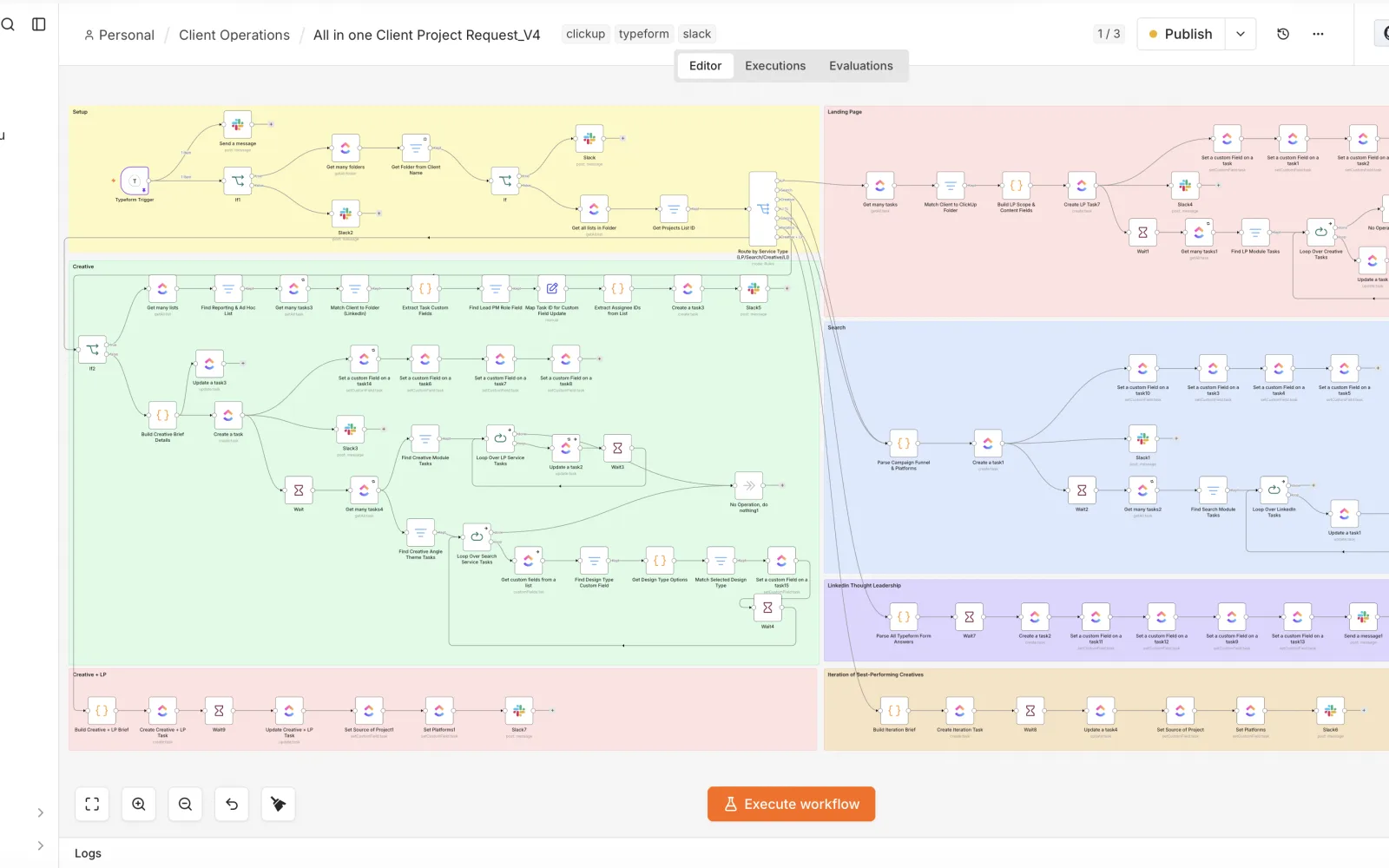
About an hour of setup per project (est.), now done by one form.
~1 hrsetup removed per project (est.)
95nodes in the live workflow
A design team's AI trial became a short, evidence-based guide: four plays, four rules and a clear list of what AI should not be asked to do.
Designers were trying AI tools on real briefs, each in their own way. Results varied, prompts were lost with the chat, and the same mistakes repeated. The team needed a shared standard, built from what had actually worked.
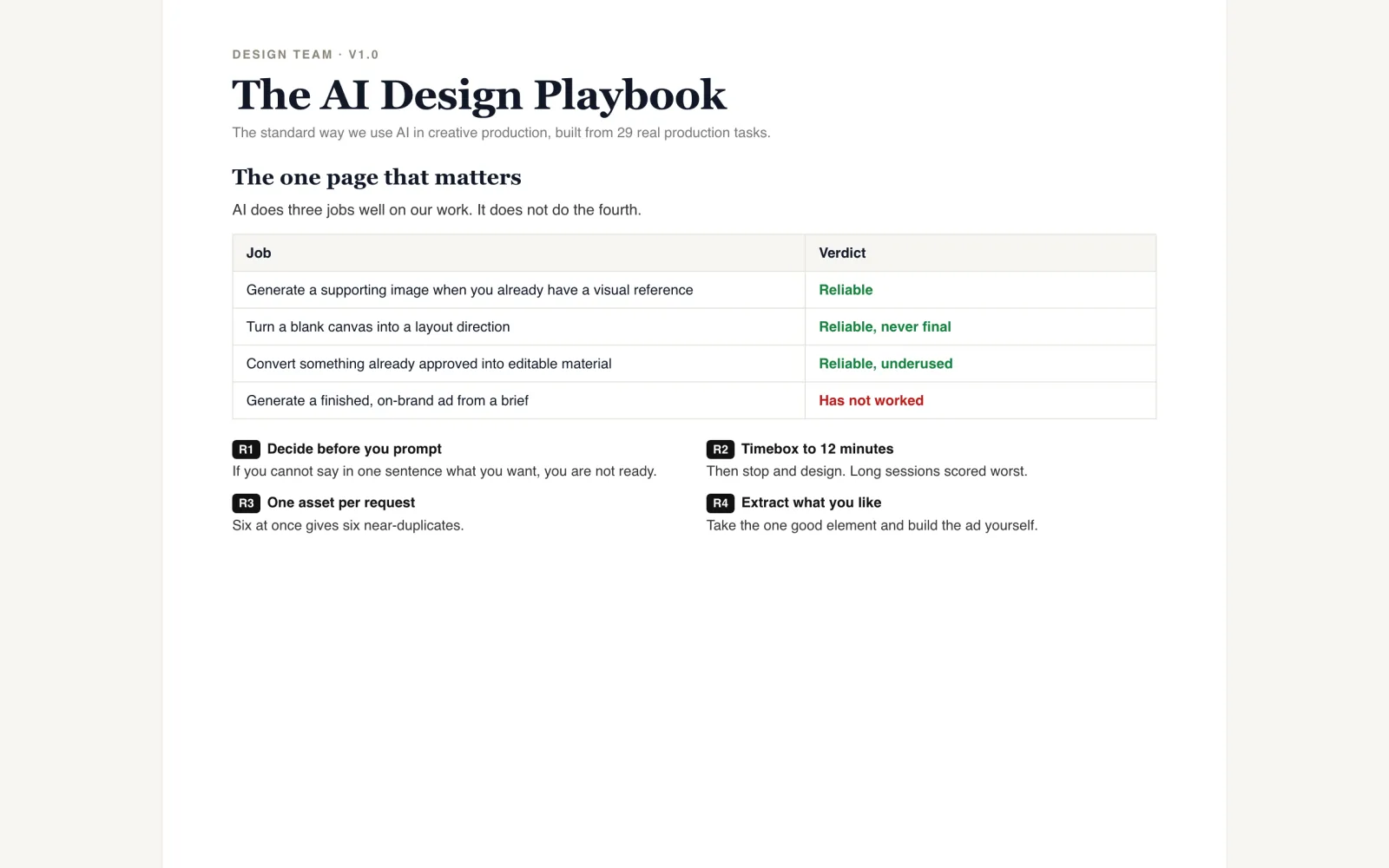
Yash compiled every task tagged as AI-assisted between 12 July and 12 August 2026, along with the designers' own ratings and notes, into one playbook. It sets out four plays, a field-by-field way to turn a brief into a prompt, and a list of anti-patterns.
Each play has a trigger, a prompt scaffold and an exit point, the moment to stop prompting and go back to Figma. A short logging routine keeps the evidence growing.
| Area | Before | After |
|---|---|---|
| Using AI on a brief | Trial and error per designer | Four named plays with exit points |
| Client context | Re-explained in every chat | Set up once per client, then reused |
| Knowing when to stop | Sessions ran on | A 12-minute timebox |
| Learning from results | Notes scattered across tasks | Ratings and notes logged in a fixed format |
The playbook turns a pilot into rules a designer can follow on day one. Its main findings: AI does three jobs reliably, it has not produced a finished on-brand ad, and sessions that ran to 15 minutes all scored 2 out of 5.
The evidence is 21 self-reported ratings from 7 designers over three weeks, with no control group. AI-assisted tasks had a 55% first-round approval rate, but the figure without AI is unknown. Nobody has yet shown that AI makes the team faster, and the playbook says so.
Every rule traces to a logged task or a designer's own words. Failures are documented as carefully as wins, and the six 2-out-of-5 sessions each produced an anti-pattern. The guide ends with a list of what is still unknown and is meant to be reviewed against approval rates at each pilot readout.
Pages are re-created from the playbook's structure. Quotes are shortened from the document.
If your team is experimenting with AI tools without a shared method, a short evidence-based playbook can replace everyone's separate trial and error.